Eight hours at a desk does specific, predictable damage. Here’s where it hits — and how to undo it.
The Koramangala Desk Worker Body: Three Patterns That Form Without Warning
Most software engineers and product managers sitting somewhere between Forum Mall and HSR Layout share the same three postural failure patterns. They develop gradually, asymmetrically, and they compound each other.
Tech Neck (Forward Head Posture)
Your head weighs roughly 5–6 kg. For every inch it drifts forward from neutral alignment — which it does when you’re reading a monitor that’s slightly too low or too far away — the effective load on your cervical spine doubles. By the time your ear is 3 inches ahead of your shoulder, your neck is managing the equivalent of carrying a 20 kg weight all day. The muscles taking that load are your upper trapezius (the ridge running from neck to shoulder that you unconsciously press when stressed), your levator scapulae (running from cervical vertebrae to shoulder blade, responsible for that deep ache when you turn your head), and your suboccipital muscles at the base of your skull — the ones generating those tension headaches that arrive reliably around 3 PM.
Mouse Shoulder (Unilateral Upper Quadrant Tension)
If you’re right-handed and using a standard desk setup, your right shoulder is chronically elevated and internally rotated. Your right pec minor is shortened. Your right rhomboids and mid-trapezius are overstretched and weak. This asymmetry isn’t just discomfort — it’s a structural imbalance that alters how your shoulder blade moves, creates rotator cuff vulnerability, and contributes to the forearm and wrist tension associated with RSI (repetitive strain injury). The Zoom fatigue layered on top — jaw clenching, sustained screen focus, fixed neck position through back-to-back calls — amplifies every millimetre of that tightness.
Anterior Pelvic Tilt (Lower Cross Syndrome)
Sitting for nine-hour sprints shortens your iliopsoas — the deep hip flexor muscle connecting your lumbar spine to your thigh. When this muscle tightens, it pulls your pelvis forward and downward, creating an exaggerated lumbar curve. Your glutes switch off. Your lumbar erectors compensate by chronically contracting. The result is the classic lower back ache that you feel standing up, climbing stairs, and — if you run — after the first kilometre. This pattern is what physios call Lower Cross Syndrome, and it’s essentially the default setting for anyone working from a chair in Koramangala’s tech ecosystem.
Why Each Pattern Needs Different Pressure Zones
This is where generic “stress relief” massage falls short for desk workers. A standard relaxation treatment applies even pressure across the back. It feels good. It reduces surface tension. But it doesn’t address the depth or specificity of chronic postural patterns.
Tech neck requires sustained, directional work on the posterior cervical chain — not just surface effleurage, but specific release of the levator scapulae attachment points and careful cross-fibre friction on the upper trapezius. Too much pressure applied incorrectly in this zone causes referred pain. Calibrated, technique-led work releases it.
Mouse shoulder requires asymmetric treatment — deeper work on the right side, specific attention to the pec minor (which requires anterior chest access), and activation work for the dormant rhomboids. You can’t address this pattern by treating both sides identically.
Anterior pelvic tilt requires lower back decompression, but more importantly it requires attention to the hip flexor complex. The iliopsoas is a deep muscle — reaching it requires specific technique, positioning, and pressure knowledge. A therapist who doesn’t assess your pelvis first will miss the root cause entirely.
How Indriya’s Deep Tissue Protocol Targets These Zones
Indriya Wellness in Koramangala doesn’t run a generic session timer. The deep tissue protocol begins with a brief postural assessment — where do you hold tension, which side is higher, what’s your primary complaint. From there, the therapist works in zones rather than in generalized strokes.
For desk-worker presentations, the protocol typically addresses the posterior cervical chain first — releasing the neck-to-skull tension that’s generating headaches and limiting rotation. It then moves through the upper trapezius and across the mid-back, before addressing the lumbar region and — critically — the hip flexors. Pressure is graduated, sustained, and adjusted based on your feedback. This isn’t the “just tell me if it hurts too much” default. It’s calibrated clinical pressure with a specific therapeutic target.
The technique combines slow myofascial release strokes with targeted trigger point work on the muscle knots that have formed in your levator scapulae and rhomboids. These trigger points refer pain — they create discomfort in zones away from where they actually are. Addressing them requires locating the point, applying sustained pressure, and waiting for the neurological release. It takes time and training. It’s exactly what differentiates Indriya’s approach from a 30-minute express chain treatment.
The Gentleman Retreat Package: Built for Desk Recovery
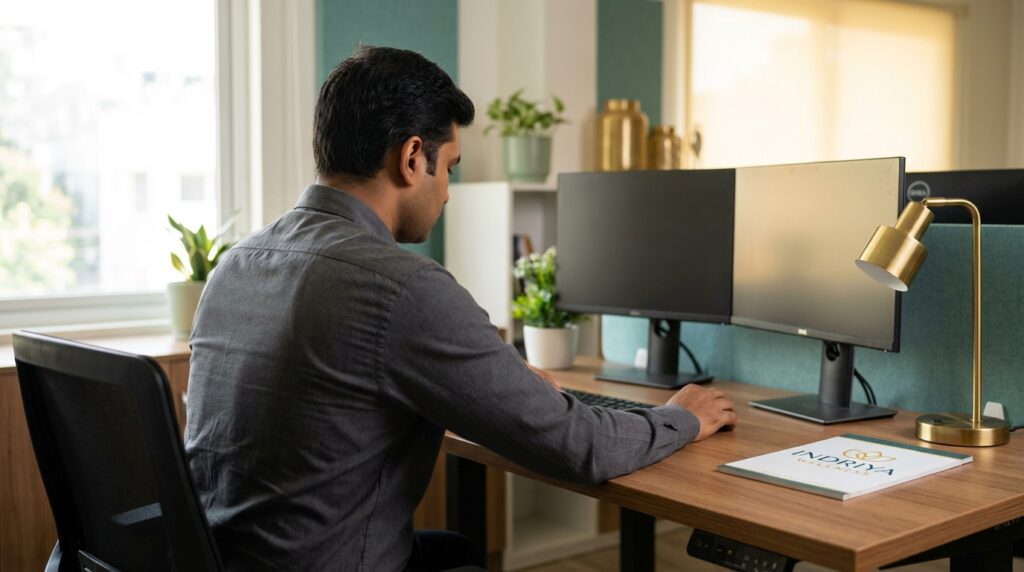
At ₹2,800, the Indriya Gentleman Retreat is the most complete option for Koramangala desk workers dealing with the full three-pattern combination. The package extends beyond a standard deep tissue session to address the complete tension profile of someone who’s been sitting in front of dual monitors, commuting on Hosur Road, and Zooming through lunch.
The session includes deep tissue work on the back and shoulder complex, specific neck and scalp work that directly addresses the tech neck pattern, and attention to the lower back and hip region for iliopsoas and lumbar decompression. The extended duration means the therapist isn’t rushing through zones — they can actually hold trigger points long enough for full neurological release, which a compressed 60-minute session simply can’t do.
For engineers and product managers between Koramangala, BTM Layout, and HSR Layout dealing with acute phase tension — where turning your head causes a wince, or where you’ve started compensating your gait — this is the package to start with.
If you’re earlier in the tension cycle and your primary concern is the desk-specific back and shoulder ache rather than the full-body decompression, the Deep Tissue session at ₹2,000 targets the posterior chain specifically and is a strong standalone option.
How Often Should You Book? Acute Phase vs. Maintenance
This depends entirely on how far the patterns have developed.
Acute phase (you’re actively in pain, rotation is limited, headaches are frequent): Start with sessions every 10–14 days for 6–8 weeks. In this phase, the tissue is contracted and reactive. One session will provide relief, but the pattern will reassert itself quickly without regular follow-up. Think of it like physio — you wouldn’t expect one appointment to resolve a structural issue.
Maintenance phase (you’re functional but recognise the tension building): Once a month is the minimum to prevent re-accumulation. Once you understand your own tension patterns — where you hold stress, which side overworks — monthly deep tissue work keeps the system from reaching the acute phase again. Many of Indriya’s regulars from HSR Layout and BTM Layout treat the monthly session as non-negotiable, the same way they’d treat a gym day.
Between Sessions: 3 Desk Stretches That Actually Work
These won’t replace professional work, but they’ll slow the re-accumulation between sessions.
Chin Tuck (Cervical Retraction): Sit tall. Without tilting your head, draw your chin straight back — as if making a double chin. Hold 5 seconds, repeat 10 times. This directly counteracts forward head posture by activating the deep neck flexors that go dormant during screen time. Do this every 90 minutes.
Doorframe Pec Stretch: Stand in a doorway, forearm vertical against the frame, elbow at 90 degrees. Step through gently until you feel the anterior shoulder and chest open. Hold 30 seconds per side, 3 times daily. This directly addresses the pec minor shortening from mouse shoulder.
90-90 Hip Flexor Stretch: Kneel on one knee, back knee on the floor, front foot flat. Shift your hips forward until you feel a stretch at the front of the back hip — that’s your iliopsoas. Tuck your pelvis slightly to increase intensity. Hold 45 seconds per side. Do this every time you stand up from a long session.
Book Your Targeted Deep Tissue Session
You’ve tried the home remedies. You know the foam roller isn’t getting deep enough. The patterns are specific, the muscles are named, and the fix requires trained hands applying the right technique in the right zones.
Built for Koramangala’s desk workers.
Book your targeted deep tissue session at Indriya Wellness — call 7411369120.
📍 Opposite Forum Mall, Hosur Road, Koramangala. 5 minutes from HSR Layout. 10 minutes from BTM Layout.
Gentleman Retreat: ₹2,800 | Deep Tissue: ₹2,000
Walk in tight. Leave moving like yourself again.